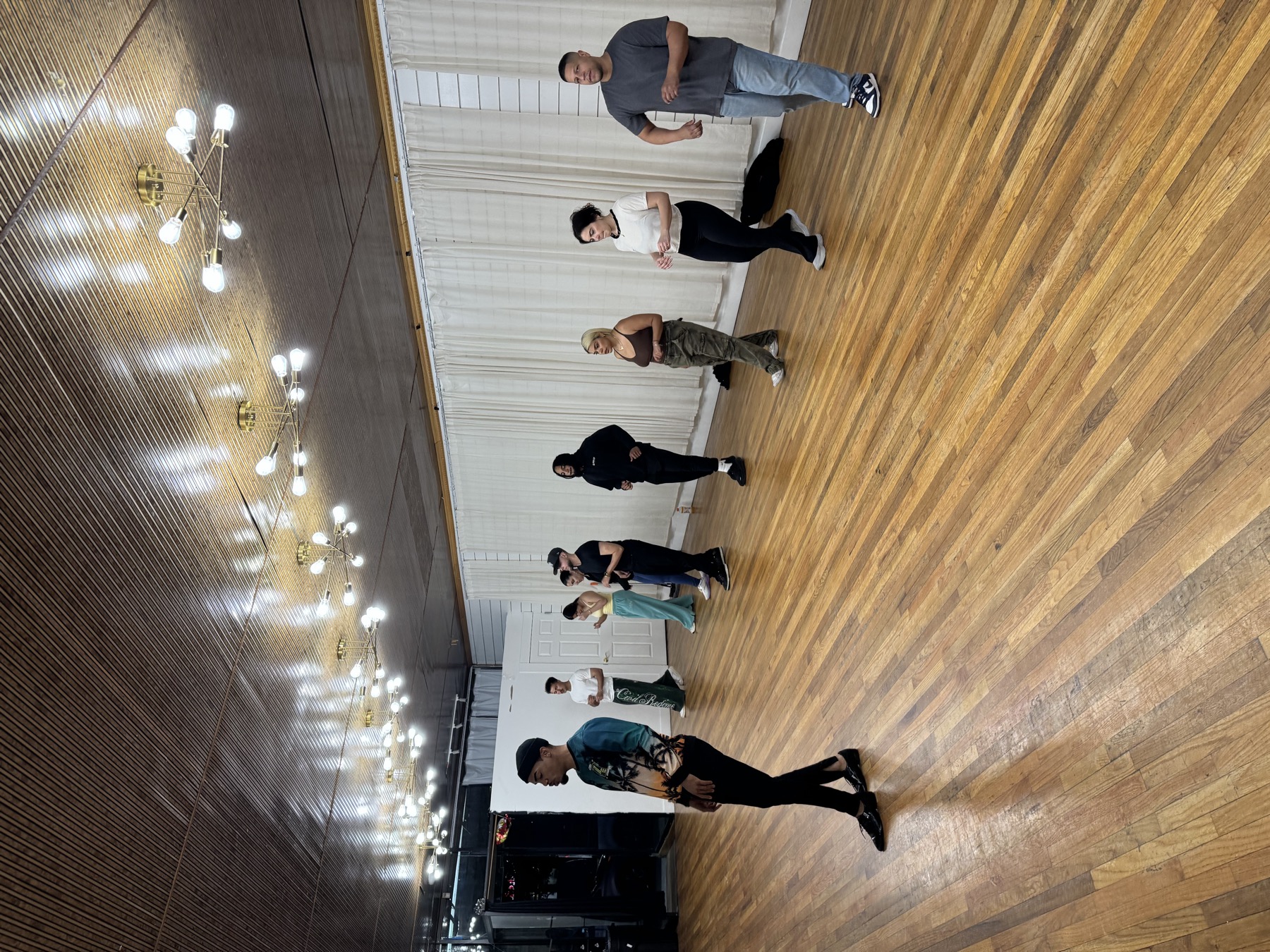
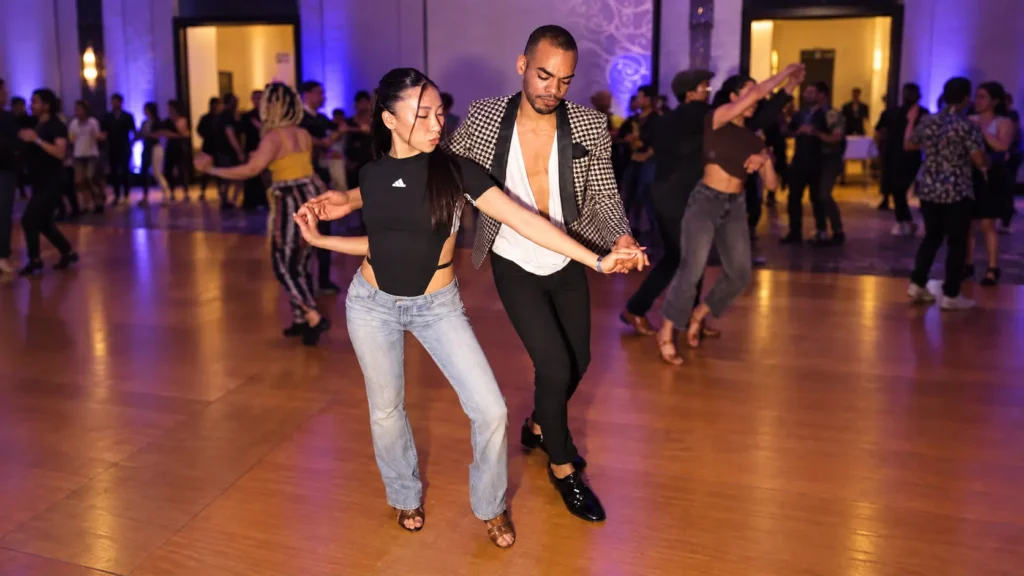
To start dancing salsa, learn the count, practice a small basic step, and transfer your weight with each step. Once you can repeat that pattern, work with a partner and an instructor on connection and simple turns. You can begin practicing the count and footwork on your own.
This guide uses a common New York–style On2 basic. It is a useful starting point for the On2 foundations taught in Jariel La Salsa’s beginner course. Salsa has several styles and timing approaches, so a tutorial that starts with a different foot or direction may be teaching a different version.
Your first goal is manageable: complete a basic step, keep the count, and repeat without rushing.
1. Understand the salsa count
For the New York On2 basic described here, take six steps across eight counts:
Step on 1, 2, 3 — continue through 4 — step on 5, 6, 7 — continue through 8.
Counts 4 and 8 still take time; you do not add another step on them in this basic. Keep counting evenly instead of squeezing the pauses out. Those eight counts cover two bars of music in 4/4 time.
“On2” describes the break steps on counts 2 and 6: the steps that lead into a reversal of direction. It does not mean you skip count 1. The common On1 basic also uses stepping counts 1, 2, 3, 5, 6 and 7, but its break steps fall on 1 and 5. Dance Dojo’s timing guide explains these distinctions and other timing variations.
Start by saying all eight numbers aloud at a comfortable, steady pace. Then make the stepping counts louder: ONE, TWO, THREE, four, FIVE, SIX, SEVEN, eight. You are learning the rhythm before adding travel.
2. Make each step a weight change
Clear a small practice area. Stand comfortably upright, let your shoulders relax, and keep your knees soft. Start with small movements rather than reaching far forward or backward. Small steps and slightly bent knees are also emphasized in instructor Jorday Rivera’s salsa posture lesson.
A step means the receiving leg takes your weight. Merely touching the floor with a foot while staying on the other leg is a tap, which will not produce the alternating weight changes you need here.
Try stepping almost in place while counting. Alternate feet on 1, 2, 3, 5, 6 and 7. Notice whether you can free the next foot without leaning or scrambling. On 4 and 8, keep your balance and let the movement continue without another weight change. This distinction between six weight changes and continuous movement is described in Mathias Ellmann’s On2 basic-step reference.
If the sequence feels awkward, make it smaller and slower. Leave decorative arm movements and exaggerated hip action for later instruction.
3. Learn the forward-and-back On2 basic
The two roles use complementary footwork. Choose one role’s sequence to practice first, and read left and right as your own left and right. Leading and following are dance roles; either can be learned regardless of gender.
Leader’s basic
Begin with your weight on your right foot so your left foot can move. Keep all traveling steps small.
| Count | Action |
|---|---|
| 1 | Step slightly back with your left foot. |
| 2 | Step back with your right foot, behind the left. This is the back break. |
| 3 | Replace your weight onto your left foot. |
| 4 | Continue the count without another step. |
| 5 | Step forward with your right foot. |
| 6 | Step forward with your left foot, ahead of the right. This is the forward break. |
| 7 | Replace your weight onto your right foot. |
| 8 | Continue the count without another step. |
“Replace” means return your weight to the other foot; you do not need to take another large traveling step. Then repeat from count 1. This sequence follows the leader’s On2 pattern described by Step Into Salsa.
Follower’s basic
Begin with your weight on your left foot so your right foot can move.
| Count | Action |
|---|---|
| 1 | Step slightly forward with your right foot. |
| 2 | Step forward with your left foot, ahead of the right. This is the forward break. |
| 3 | Replace your weight onto your right foot. |
| 4 | Continue the count without another step. |
| 5 | Step back with your left foot. |
| 6 | Step back with your right foot, behind the left. This is the back break. |
| 7 | Replace your weight onto your left foot. |
| 8 | Continue the count without another step. |
Repeat from count 1. Some beginner demonstrations keep counts 1 and 5 closer to in place; the essential pattern is the alternating weight changes and the breaks on 2 and 6. Salsa Vida’s beginner On2 guide provides a further reference for both roles.
Practice a few repetitions without music. Say the foot names if that helps, then return to the numbers. If you lose track, stop, place your weight on the starting foot, and begin again.
A little personal guidance
Make your next step clearer.
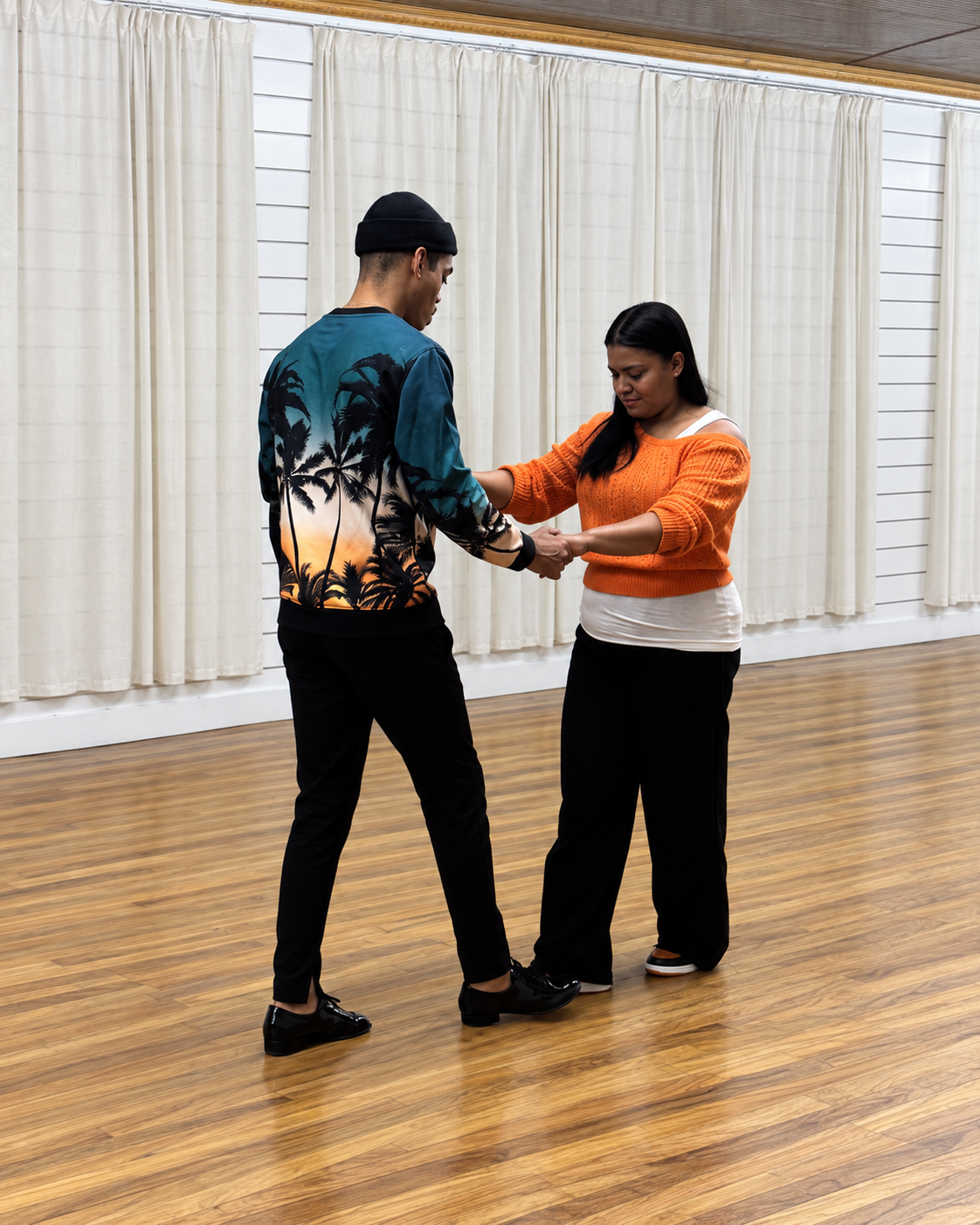
If you want individual feedback on a particular difficulty, such as timing or weight transfer, explore Jariel’s private salsa lessons. The focus can be tailored with Jariel to what you want to work on.
4. Put the basic step to music
Choose a salsa recording whose pace lets you complete each weight change comfortably. Listen before you move. Try counting evenly from 1 to 8, then add your basic step while keeping the same pace.
Counting steadily and identifying the musical 1 are different skills. If you can recite the numbers but cannot tell where the phrase starts, ask your instructor to count over a recording with you. You do not need to solve every percussion pattern during your first practice.
For now, use a simple check: can you keep the same sequence when the singing or instrumentation changes? If you begin chasing every sound with your feet, pause and return to the count. Work through a short section of music, then stop and check what became difficult.
5. Add a partner before adding complexity
Once each person can repeat their own basic, practice facing one another with comfortable space between you. Agree on the timing and roles first. Begin without a handhold if that makes it easier to concentrate on the count.
When you add contact, ask an instructor to show you a comfortable connection. Each dancer should carry their own balance; avoid gripping, pulling, or using your partner to stay upright. Either person can ask to slow down or stop.
Keep the first exercise to a shared basic. A successful repetition gives both dancers time to move and recover. You can then learn turn preparation and a cross-body lead—the pathway in which one partner makes room for the other to travel across—with guidance. Detailed hand positions and turn mechanics deserve their own lesson.
What to check when the basic feels difficult
- You need an extra step to catch yourself. Reduce the distance you travel and check that each stepping count receives your weight.
- Your feet become tangled. Return to stepping almost in place, then reintroduce forward and backward movement.
- You rush from 3 to 5 or 7 to 1. Say 4 and 8 aloud so those counts keep their full time.
- A different tutorial seems contradictory. Check its timing, dance role, and whether the demonstration is mirrored before changing your pattern.
- You can do the steps alone but lose them with a partner. Return to a shared basic at a comfortable pace and ask for feedback on connection.
Choose one thing to work on at a time. For example, repeat the basic while focusing only on keeping counts 4 and 8, then check weight changes in the next repetition.
Take your next step with guidance
You do not need a collection of moves before joining a beginner class. Bring the question you noticed while practicing: which foot carries your weight, where the break happens, or how to hear the count in a song.
Jariel Garcia, known as Jariel La Salsa, is a New York City dancer and instructor. His Salsa FUN-2-Mentals course introduces New York–style Salsa On2, including timing, basic steps, weight transfer, and partner connection. Classes take place at Something Untouchable Dance Studio on West 145th Street in Hamilton Heights, Uptown Manhattan. No previous dance experience or partner is required.
Frequently asked questions
Can I start learning salsa without a partner?
Yes. Start on your own with the count, small basic steps, and clear weight changes. Partner connection is a separate skill to practice with another dancer and an instructor. Jariel’s beginner course does not require you to bring a partner.
Which counts do I step on in this On2 basic?
Step on 1, 2, 3, 5, 6, and 7. Keep counting through 4 and 8 without adding another step. The break steps happen on 2 and 6; dancing On2 does not mean skipping count 1.
Which foot should I start with?
For the version in this guide, leaders begin with their weight on the right foot and step slightly back with the left on count 1. Followers begin with their weight on the left foot and step slightly forward with the right. Check the dance role and timing before comparing another tutorial.
What is the difference between salsa On1 and On2?
Both basics commonly use stepping counts 1, 2, 3, 5, 6, and 7. The difference described here is the timing of the break steps: on 1 and 5 for On1, and on 2 and 6 for this New York–style On2 basic. Agree on the timing before practicing with a partner.
What should I do if I keep losing the count?
Make your steps smaller and practice without music first. Say all eight counts aloud, including 4 and 8. When you add music, choose a comfortable pace. If you can count steadily but cannot find the musical 1, ask your instructor to count over a recording with you.
Do I need to learn turns before joining a beginner salsa class?
No. Your starting goals are a repeatable basic, clear weight changes, and a steady count. Jariel’s beginner course introduces On2 foundations, including timing, basic steps, weight transfer, and partner connection. Bring any questions you notice while practicing.